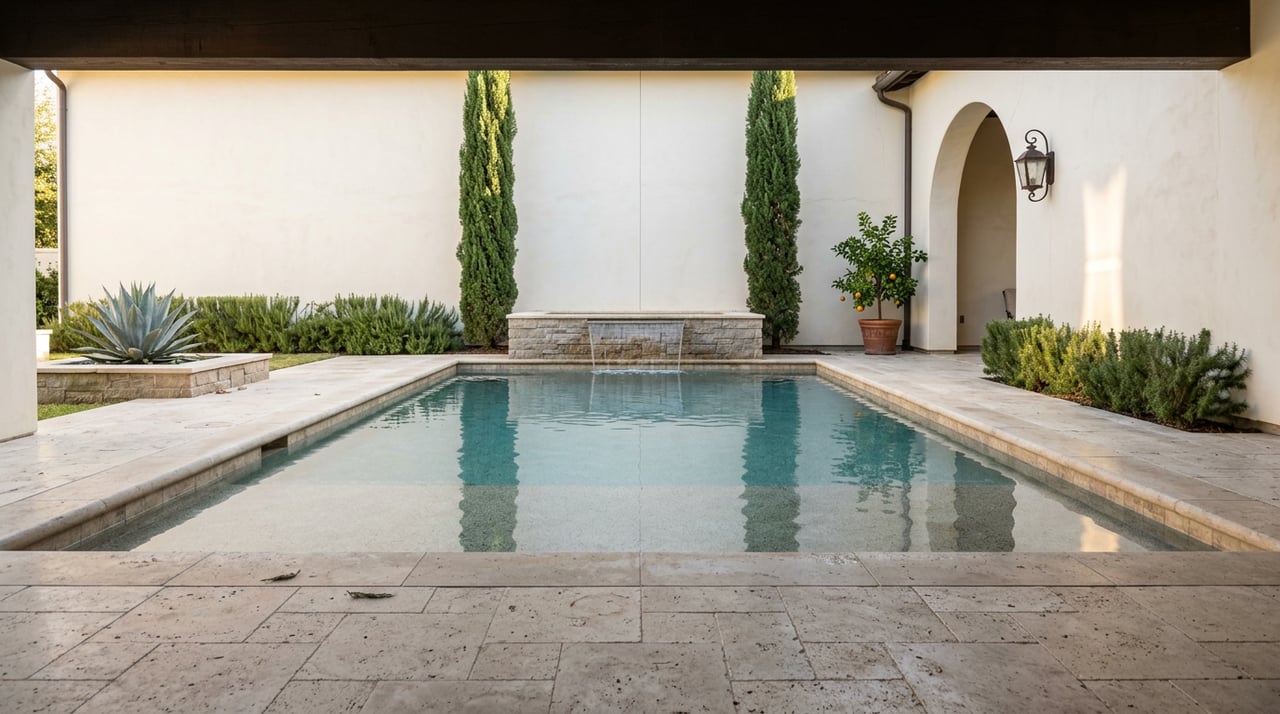
A buyer touring homes in Redhawk or Wolf Creek this summer runs into the same wall eventually. They fall for a house with a pool, write an offer that reflects what pool homes have been selling for, and then the appraisal comes back short. Not because the house isn't worth the price. Because the appraiser and the buyer are pricing two different things, and only one of them is actually the pool.
That gap is worth understanding before you write an offer or sign a listing agreement, because it changes how you should think about the number on the sign.
The Premium Everyone Quotes
Temecula's citywide median sale price sat at $775,000 as of May 2026. Pool homes in the same market averaged $1,044,260, a gap of roughly $269,000. The city's MLS currently shows around 222 active listings with a pool, and about 122 of those have a true private pool rather than shared or community access. That $269,000 spread is the number that gets repeated in listing conversations, and it's the number that makes buyers assume a pool is worth adding $200,000-plus to an offer.
It isn't. Appraisers working the Temecula and Murrieta corridor typically credit the pool itself somewhere between $50,000 and $70,000. The rest of that headline gap, the other $200,000, is doing something else entirely: it's the lot size, the view, the age of construction, and the neighborhood the pool happens to sit in.
Pools in this market cluster in specific places for a reason. South Temecula communities like Redhawk and Morgan Hill, both zoned for Great Oak High School, carry larger parcels and command higher prices independent of whatever is in the backyard. Zip code 92592, which covers that corridor along with Wolf Creek, was running as a very competitive market as of June 2026, with homes averaging two offers and selling in about 40 days. Zip code 92591 to the southwest, covering areas like Paloma del Sol, was more moderate, with a median around $743,000 and closer to 56 days on market. A pool home in 92592 isn't expensive because of the water feature. It's expensive because it's in 92592.
Buyers chasing acreage rather than a school zone see the same pattern at a different scale. Out past Butterfield Stage Road, five-acre parcels with equestrian setups in Glen Oaks and Oakridge Ranches start well north of $1 million, pool or no pool. Further west in De Luz, working agricultural parcels of nine acres or more start around $1 million as well. None of that premium traces back to a backyard pool. It traces back to land.
What the Appraiser Actually Signs Off On
This is the part that catches buyers off guard mid-transaction. An appraiser isn't pricing the lifestyle a pool represents. They're comparing recent sales and isolating what a pool specifically adds, holding lot size, view, and build year constant. In the Temecula and Murrieta corridor, that isolated value lands at $50,000 to $70,000.
So if a buyer bids up a Redhawk listing believing the full $269,000 gap between pool and non-pool homes reflects the pool's contribution, and the appraisal only supports $50,000 to $70,000 of that on top of comparable non-pool sales, the loan doesn't cover the difference. The buyer either brings cash to close the gap, renegotiates, or walks.
Sellers run into the mirror image of this problem. A homeowner who assumes their pool alone justifies pricing at the top of the pool-home range is really banking on their lot, their view, and their build vintage doing that work too. If those don't measure up to the comps that set the high end of the range, the pool won't carry the price on its own.
The Bill That Starts After Closing
Even the $50,000 to $70,000 the appraiser does credit isn't money in the bank. It has to compete against what the pool actually costs to keep.
Routine service in this climate runs $3,600 to $6,000 a year for weekly chemical balancing and cleaning. A heater or saltwater system adds another $1,200 to $2,400 annually. Resurfacing, which every plaster or pebble finish eventually needs, runs $8,000 to $15,000 and comes due every 10 to 15 years. Current Temecula-specific contractor quotes put average resurfacing closer to $6,335, with a range from $3,000 to $15,000 depending on scope, so the low end of that older estimate still holds up. In drought years, surcharges on top-off water can add another $800 to $1,500.
Stretch that across a 15-year hold and the total runs $80,000 to $120,000. That's not a rounding error against the $50,000 to $70,000 the pool actually added at resale. It's larger than it, in many cases by a wide margin. The math doesn't say a pool is a bad idea. It says a pool is not an investment that pays for itself through resale value. It's a lifestyle expense that happens to be partially offset by a modest bump in what the house is worth.
The HOA Bill Complicates the Comparison Further
Some of that math changes depending on whether a private pool is even the right comparison. A lot of Temecula's master-planned communities fold pool access into HOA dues instead of requiring a private backyard pool at all. Harveston, Morgan Hill, and Paseo del Sol all include resort-style community pools as part of their amenity package, and a buyer who's fine sharing a pool with neighbors can skip the private-pool carrying costs altogether.
The dues to get that access vary sharply. Older Redhawk tracts can run as low as $34 a month. Newer, amenity-heavy communities like Sommers Bend run $330 a month or more, and the newest developments increasingly stack HOA dues on top of Mello-Roos assessments, adding $400 or more a month before principal and interest even enter the picture. Part of that increase isn't about new amenities either. Insurance now eats roughly 22% of the average HOA budget in this market, up from about 12% three years ago, and boards in wildfire-exposed associations have pushed that share past 30%. Dues are climbing across the board, private pool or not.
Most of Temecula's Pools Are Old Enough to Need Work Soon
There's a timing issue layered on top of all of this. A large share of Temecula's housing stock, including its pools, dates to the 1990s and early 2000s building boom that shaped much of the city. A pool built in that window is now old enough that resurfacing isn't a hypothetical line item. It's likely due, or overdue.
That matters directly for a buyer evaluating a resale pool home. Ask when the pool was last resurfaced. If the answer is "never" or "more than 12 years ago," budget for that $6,000-plus expense in year one rather than year ten. Any resurfacing work involving structural changes, equipment upgrades, or deck modifications requires a permit from the city's Community Development Department, so factor permitting timelines into any renovation plan before assuming a quick turnaround.
So Is a Pool Worth It?
The pool premium in this market is real, but it's smaller and more complicated than the headline gap between pool and non-pool median prices suggests. Most of that $269,000 spread is explained by where pool homes tend to sit, not by the pools themselves. The portion that actually belongs to the pool, $50,000 to $70,000, gets largely absorbed by ownership costs over a typical hold period.
None of that means skip the pool. It means buy it for the right reason. If the goal is resale equity, the lot, the school zone, and the build year are doing more financial work than the water feature ever will. If the goal is a backyard that gets used through a Temecula summer, that's a different calculation entirely, and the carrying costs are simply the price of that use, not a bad investment.
For sellers, the practical takeaway is pricing discipline. Don't price a pool home at the top of the comparable range unless the lot, view, and vintage support it independent of the pool. For buyers, get the pool's service and resurfacing history before you write an offer, and don't assume the full pool-home premium will survive an appraisal.
Frequently Asked Questions
Does a pool guarantee a higher appraisal in Temecula? No. Appraisers isolate the pool's contribution separately from lot size, view, and construction vintage, and in the Temecula and Murrieta corridor that isolated value typically runs $50,000 to $70,000, well below the raw price gap between pool and non-pool home sales.
How old is the typical pool in a Temecula resale? Much of Temecula's housing stock, pools included, dates to the 1990s and early 2000s development boom, which means many resale pools are old enough to need resurfacing now or within the next few years.
Do I need a permit to resurface a pool in Temecula? Pool remodeling that involves structural changes, equipment upgrades, or deck modifications requires a permit through the city's Community Development Department. Straightforward cosmetic resurfacing quotes typically factor permit coordination into the project timeline.
If you're weighing a pool home against a non-pool comparable, or trying to price a listing that has one, the math above only gets more specific once we're looking at your actual address, lot, and comps. Meeker Realty Group works these numbers block by block across Temecula and the surrounding valley. Get Your Free Home Valuation and we'll walk through exactly what your pool, and everything around it, is actually worth in today's market.